
What is Dialectical Behaviour Therapy?
TLDR: There are many types of therapy. But how do you know which therapy is the right fit for you? Learn all about Dialectical Behaviour Therapy, its origins in CBT and how you can access it.

Dialectical Behaviour Therapy (DBT) is a practical, evidence-based approach to managing strong emotions and intense mental health difficulties.
DBT is a form of Cognitive Behavioural Therapy (CBT). Initially based on CBT’s focus on identifying and changing unhelpful thoughts and behaviours, DBT was specifically adapted for people who experience intense emotions. Through this adaptation, DBT integrates CBT with elements of acceptance and mindfulness as therapeutic tools.
This means you learn to notice and accept your feelings, even the tough ones, instead of just trying to get rid of them.
As a therapy framework, Dialectical Behaviour Therapy was originally developed for those who feel emotions intensely, such as people with Borderline Personality Disorder (BPD) or people who have thoughts of self-harm.
The word Dialectical in DBT means bringing together two opposite or contradictory ideas. Accepting your feelings and also trying to change them can feel contradictory. Within Dialectical Behaviour Therapy frameworks, you can learn how to focus on both change-oriented goals AND a balanced self-acceptance.
While CBT is designed to support you in challenging unhelpful thought patterns, DBT does this too, but also supports you to accept the thoughts that come up and find ways to navigate those patterns without shame.
DBT is all about finding a balance between accepting things as they are and making positive changes where you can.
Who does DBT treat?
Even though DBT was initially developed in the 1980s to support women who experienced self-harm and people diagnosed with BPD, it is now used to help anyone—regardless of gender—who struggles with intense emotions or overwhelming thoughts.
Some studies have indicated there are benefits of practising DBT for those with substance abuse disorders, those with eating disorders (like binge-eating disorders) and those who struggle with depression and anxiety.
Dialectical Behaviour Therapy is best administered through a mixture of delivery methods. These include:
1:1 therapy sessions with a DBT-trained psychologist
Group therapy sessions with other people who experience similar intense emotions.
Homework completed outside sessions to integrate DBT practices into your daily life
To determine if DBT is the best treatment for you, speak with your GP or a mental health professional.
How does DBT work?
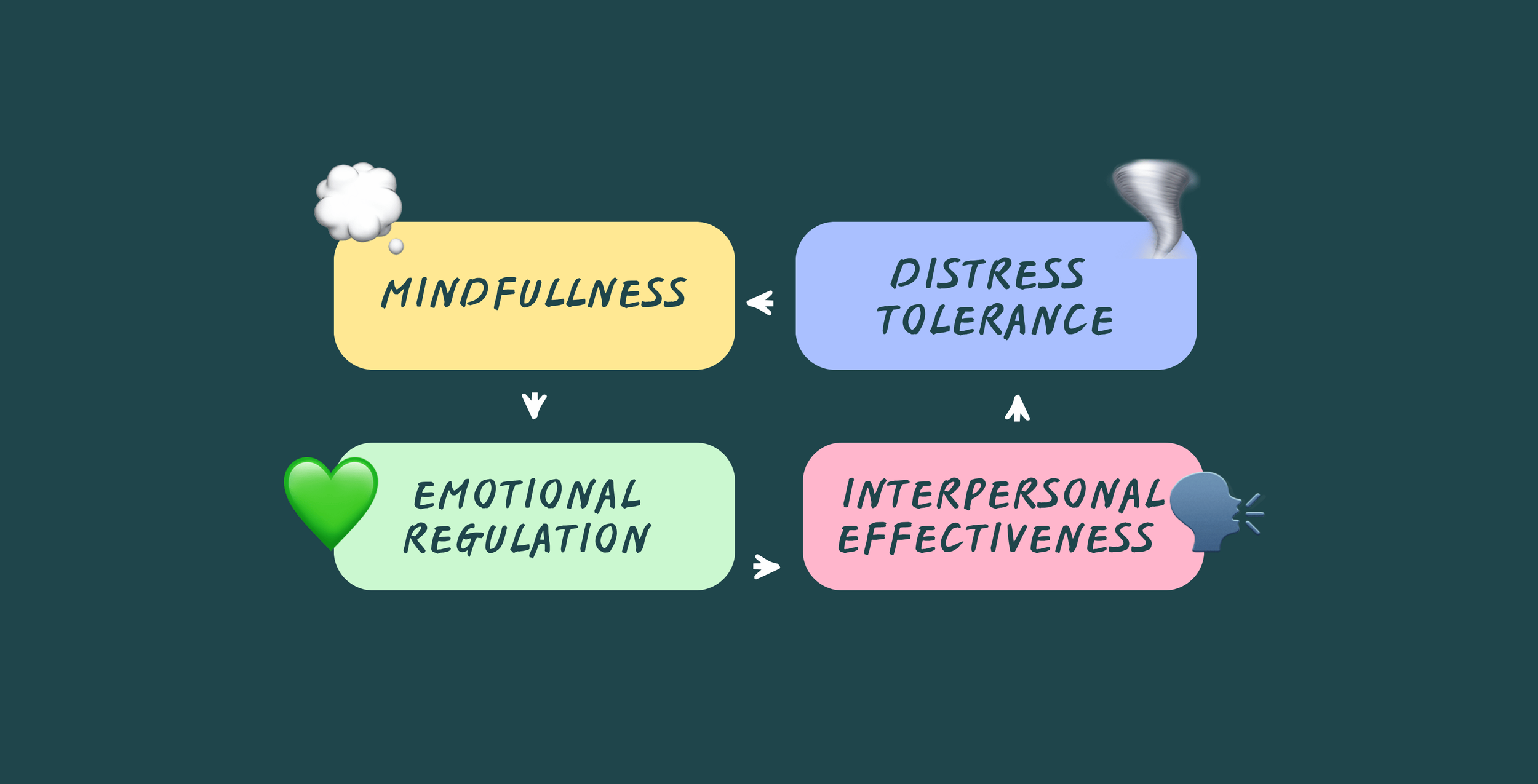
There are four key principles of DBT:
Emotional regulation skills
Distress tolerance
Interpersonal effectiveness
Mindfulness
1. Emotional regulation
Emotional regulation in DBT refers to understanding your emotions and managing them more effectively, especially when they feel intense or overwhelming.
From its early origins, DBT has had a distinct focus on managing difficult emotions without shame. Unlike some therapies that focus only on changing your feelings, Dialectical Behaviour Therapy first helps you to notice and accept feelings for what they are.
This means learning to recognise, “I’m feeling really angry/sad/anxious right now,” without immediately trying to push those feelings away.
With a DBT therapist, you’ll work to understand the root cause of your distress and identify actions that truly support your needs, rather than simply reacting in the way your emotions urge you to.
Through emotional regulation, you can foster self-acceptance, make clearer decisions, and regain control of your actions in intense emotional situations.
2. Distress tolerance
Distress tolerance is how you respond to difficult or stressful situations. It's a helpful skill for anyone, but particularly those who are prone to self-sabotage or impulsive behaviour when upset.
In DBT, you will use distress tolerance skills like self-soothing, so if a crisis occurs, you are better equipped to handle it. A big part of distress tolerance is accepting reality as it is, even if you don’t like it.
This acceptance can help you move forward, instead of getting stuck in difficult emotions or reacting in ways that hurt you.
3. Interpersonal effectiveness
This aspect of Dialectical Behaviour Therapy focuses on how you effectively balance and manage your relationships with other people.
Our feelings can sometimes get in the way of navigating relationships in a healthy way, so DBT focuses on practical ways to manage this.
In DBT, you will learn how to strengthen current relationships, how to foster new connections, and how to end toxic or unhealthy relationships. By developing your interpersonal effectiveness, you will also learn how to create and maintain healthy boundaries in your relationships.
This can help you reduce harm from others and prevent you from harming them in return.
4. Mindfulness
Mindfulness is a common skill used in lots of therapies, but it is particularly helpful in DBT. Mindfulness strategies support you to ground yourself in the present moment.
In DBT, mindfulness can help raise your awareness of your emotions, thoughts and urges. This awareness can make it easier to pause before reacting impulsively, giving you more choice over how you respond.
Mindfulness can also help you identify the outcome you’re hoping for in a situation. It can help you be more mindful of how your actions in the present can support your future goals.
Mindfulness is the foundation of all other DBT skills: emotional regulation, distress tolerance, and interpersonal effectiveness. Together, these skills can support your mental well-being and help you respond to life’s challenges in healthier ways.
What is the evidence for DBT?
Dialectical Behaviour Therapy is an effective treatment that has been adapted from the central pillars of Cognitive Behavioural Therapy (CBT).
Initially designed in the 1980s, Dialectical Behaviour Therapy (DBT) has since evolved into one of the most evidence-based psychological treatments for individuals experiencing emotional dysregulation and impulsive behaviours.
Numerous clinical trials and reviews have demonstrated that DBT can effectively reduce self-harm, suicidal behaviours, and improve overall emotional well-being.
Research consistently shows that utilising DBT leads to long-term:
Improved emotional regulation
Reduced frequency and severity of self-destructive behaviours
Enhanced interpersonal functioning and quality of life
Because of its strong research support, DBT is recommended by leading mental health organisations and is widely implemented in clinical settings worldwide.
Its combination of cognitive-behavioural strategies, mindfulness, and acceptance skills sets it apart as a comprehensive treatment approach for managing intense emotions and complex mental health challenges.
How can I get DBT?
Start by talking to your GP or a mental health service—they can refer you to a psychologist or therapist.
In Australia, you may be able to access subsidised sessions through a Mental Health Care Plan (MHCP). To get a MHCP, you need to speak to your GP.
Some schools, headspace centres, or digital programs offer DBT-based support. DBT is also available in self-help formats if you prefer to try it on your own.
How does DBT relate to Mello?
Treatments like ACT, DBT and CBT are designed to support those suffering from mental health disorders like anxiety and depression. Mello is designed to support you through stuck thinking, something that is a key driver of both anxiety and depression. Stuck thinking is when you repeatedly go over negative thoughts in your mind, otherwise called worry and rumination.
The Mello app supports you with exercises, techniques and tools to get unstuck the moment you need to.
In Mello, you’ll learn techniques like reframing thoughts and seeing problems from different angles. You’ll practice self-compassion and separating yourself from your thoughts. Everything in Mello is designed with young people, so it feels relevant and easy to use.
You can download Mello for free from the Apple App Store and Google Play now.
Further DBT Resources
Linehan, M. (2015). DBT skills training handouts and worksheets (Second edition.). The Guilford Press.
Andrade, D., Davidson, L., Robertson, C., Williams, P., Leung, J., Walter, Z., Allan, J., & Hides, L. (2024). Randomized effectiveness‐implementation trial of dialectical behavior therapy interventions for young people with borderline personality disorder symptoms. Journal of Clinical Psychology, 80(10), 2117–2133. https://doi.org/10.1002/jclp.23725
Ornelas, A. C. (2024). Transdiagnostic Approaches in Cognitive Behavioral Therapy (1st ed. 2024.). Springer Nature Switzerland. https://doi.org/10.1007/978-3-031-63494-9
Asarnow, J. R., Berk, M., Bedics, J., Adrian, M., Gallop, R., Cohen, J., Korslund, K., Hughes, J., Avina, C., Linehan, M., & McCauley, E. (2021). Dialectical Behavior Therapy for Suicidal Self-Harming Youths: Emotion Regulation, Mechanisms, and Mediators. Journal of the American Academy of Child and Adolescent Psychiatry. https://doi.org/10.1016/j.jaac.2021.01.016
Written by The Mello team
on October 19th, 2025
Last reviewed on June 12th, 2026