
BLOG ● DEEP DIVE ● 5 MINS
What is Acceptance Commitment Therapy? (ACT)
The Mello Team


TLDR:
Acceptance Commitment Therapy is a type of therapy that helps you to accept your thoughts and feelings rather than control or change them.
It also helps you identify what matters most to you and take meaningful steps in that direction. In this article, we explore the methodology behind ACT, the benefits of ACT, and how to access ACT support.
What does ACT mean?
Acceptance Commitment Therapy (ACT) is a practical, evidence-based approach to managing thoughts, feelings and behaviours in your daily life.
Unlike other therapeutic treatments like Cognitive Behavioral Therapy (CBT) that seek to identify and change thoughts, ACT teaches us to acknowledge, understand, and accept our feelings without judgement.
The core principles of ACT centre on self-acceptance and moving forward with values-aligned behaviours.
Intro to Acceptance Commitment Therapy
ACT was initially developed in the late 1980s by psychologist Steven C. Hayes and his colleagues. Hayes developed the treatment to fill a gap within existing cognitive and behavioural therapies that he deemed limited due to their focus on reducing a person’s symptoms rather than promoting a broader improvement in general psychological well-being.
Acceptance Commitment Therapy emerged from these traditional behavioural therapies (like CBT and DBT among others) by combining self-acceptance and mindfulness techniques with behavioural change.
One of the purposes of Acceptance Commitment Therapy is to reduce the struggle we have with our thoughts and feelings, rather than seeing them as something to be ashamed of or pushed away. Once this acceptance has been fostered, the ACT framework supports you to focus on aligning your current and future behaviour with your personal values to lead a life that feels meaningful to you.
ACT helps reduce the impact of difficult thoughts and feelings by changing your relationship with them, making it easier to move forward and build a life guided by your values.
How does ACT work?
Many of ACT’s roots are in Relational Frame Theory (RFT), which is a psychological framework that explores our relationship between our thoughts, feelings and our identity. RFT suggests that as people, we often create associations between words, concepts and experiences – and that these associations shape how we think and feel.
A key challenge this can create is when we perceive our internal thoughts as absolute truths, rather than acknowledging and understanding them as mental events that arise and pass. This is known as cognitive fusion.
For example, you may treat the thought ‘I’m a failure’ as an absolute fact, rather than a thought your mind has produced in a given moment. When fused with our thoughts in this way, we often respond by trying to avoid our thoughts or feelings, and the circumstances that trigger them. Over time, this pattern can worsen our mental health and make it harder for us to lead meaningful, well-rounded lives.

The key principles of ACT
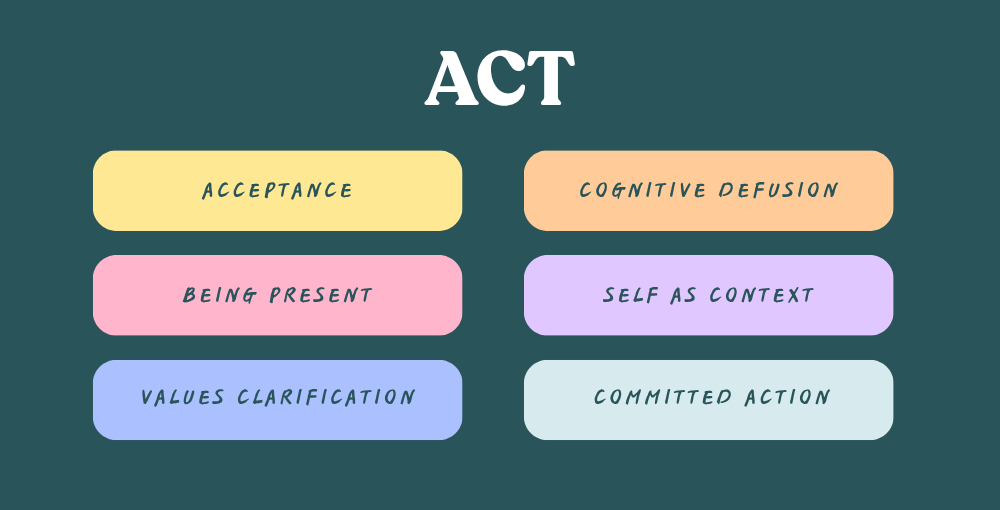
ACT is built around six core processes that work together to develop psychological flexibility – the ability to accept difficult thoughts and feelings without being controlled by them, while taking action guided by your personal values.
The key ACT processes are:
1. Acceptance
Acceptance involves making room for your emotions and thoughts (including the unpleasant ones) rather than struggling with them or avoiding them. ACT sees all emotions and thoughts as part of our natural and normal human experience, which can help foster a sense of self-compassion.
Acceptance is not about giving up, liking or agreeing with your thoughts and feelings, it is about making room for them so they have less power over you and your behaviour.
2. Cognitive defusion
Cognitive defusion helps you create psychological distance between you and your thoughts. This way you can see your thoughts as passing mental events, rather than absolute facts.
Instead of ‘I am a failure’, cognitive defusion helps you recognise ‘I am having the thought that I am a failure’, which creates distance and reduces the thoughts grip on you.
3. Being present
Being present and mindful is an integral part of ACT. This principle focuses on maintaining non-judgement awareness of your present reality, and in turn reduces your chance of thoughts spiraling as you are paying keen attention to the moment, rather than ruminating on past or possible future events.
4. Self as context
Similar to cognitive defusion, this ACT principle focuses on separating us as the self from the thoughts we have. Specifically, this principle helps you recognise that you are not your thoughts, feelings or experiences – you are the person who observes them.
Think of it like being the sky rather than the weather; the weather changes constantly, but the sky always remains. This can create a stable sense of self, even when thoughts or feelings change.
5. Values clarification
Along with acceptance, values driven behavior is the other key part of ACT. Values clarification seeks to support your mental well-being by making you aware of what is genuinely meaningful to you and in turn, supporting you to lead a purpose-driven life, aligned with your personal values.
This also limits you from being driven by your emotions and instead focuses on behaviour that aligns with your values.
6. Being present
This principle is focused on goal-setting and practical behaviours. Committed action means taking concrete steps towards goals that are in line with your values, managing obstacles that may pop up, and persevering so you can lead a meaningful life that’s in line with your purpose, goals and values.
While you commit to acting in line with your values, you’re able to focus more squarely on what you can control, rather than the emotions or thoughts you can’t.
Each of these principles are used together in ACT to support you to live a meaningful life aligned to your values and foster an acceptance of self without shame or judgment.
Further ACT Resources
A-Tjak, J. G. L., Davis, M. L., Morina, N., Powers, M. B., Smits, J. A. J., & Emmelkamp, P. M. G. (2015). A meta-analysis of the efficacy of acceptance and commitment therapy for clinically relevant mental and physical health problems.
Ruiz, F. J. (2012). Acceptance and commitment therapy versus traditional cognitive behavioral therapy: A systematic review and meta-analysis of current empirical evidence.
Swain, J., Hancock, K., Dixon, A., & Bowman, J. (2015). Acceptance and commitment therapy for children: A systematic review of intervention studies.
You might also like…

FOUNDATION
Stuck thinking & the science behind Mello.
2 minute read • 8th Oct, 2024

INTERVIEW
A chat with Dr Mario Alvarez-Jimenez.
6 minute read • 21st Oct, 2024
OVERVIEW
Written October, 2025
WRITTEN BY
The Mello Team
OVERVIEW
Written October, 2025
WRITTEN BY
The Mello Team

Unwind your mind
today with Mello.

